
Co-regulation vs regulation

You may be a teacher, or someone who works with children and young people in another capacity. You might recognise and remember children and young people, who you have worked with, who seem to struggle to engage with learning, no matter the approach you take. Or perhaps, you are a parent who has seen this challenge first-hand.
We expect and ask children to self-regulate every day. Whether this is focusing on a task, sitting still, managing emotions, making better choices.
But here’s the uncomfortable truth and something I have also learned as I have moved through my career in education:
Self-regulation is not something children can do alone, until it has first been done with them.
As children grow up and they progress through school, they may encounter some significant life events such as: moving home, the arrival of a new sibling, bereavement or parental separation, all of which can influence their wellbeing and behaviour (Grimmer, 2023) – not forgetting a pandemic! Life can certainly throw some curve balls and young people have a lot to deal with as they grow up.
We also know that children do not all have the same start in life. Children arrive at the classroom door in very different emotional states. We often expect children to regulate their emotions independently – but the ability to self-regulate doesn’t appear with age. It has to be developed through relationship. But the child who has a disturbed homelife and so doesn’t have a role model at home who can model healthy regulation arrives at school the very opposite to ‘calm’. Indeed, children’s ability to learn and feel secure can be affected by a wide range of factors. For example, family pressures, illness, and experiences of neglect can inhibit their emotional stability and capacity to engage in learning.

So, when we tell a child to ‘calm down’ – what do we mean by this phrase? And more importantly, are we asking them to do something they’ve never actually been taught how to do? And, are we, ourselves, calm?
Despite a growing awareness of children’s mental health and wellbeing, many behaviour approaches in schools still rely on the assumption that children can independently regulate their emotions.
Yet neuroscience tells us differently. The ability to self-regulate is not innate, it is built over time through repeated experiences of co-regulation.
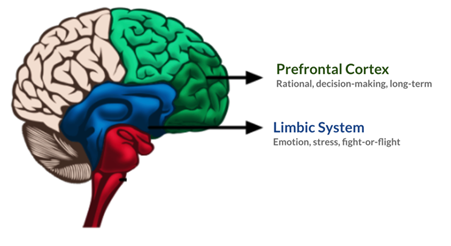
The brain is made up of three parts. The brain develops from the bottom up (Van Der Kolk, 2014). The reptilian brain develops in the womb – it’s also very responsive to threat throughout life. The limbic brain is developed and organised through the first six years of life and continues to evolve. Trauma can impact this part of the brain and how it functions. The last part to develop is the prefrontal cortex – this part is also affected by trauma exposure. This part can almost go off line in response to a perceived threat.
Understanding how the brain develops and responds to threat helps explain why some children are unable to regulate their emotions and behaviour independently. Before they can access the thinking part of their brain, they first need support from a calm, attuned adult. This is where co-regulation becomes essential, providing the external regulation they need until they are able to manage it for themselves.
Essentially, co-regulation is the process of an adult supporting a child to regulate their emotional state.
Co-regulation is a supportive process that relies on a foundation of a warm, responsive and trusting relationship between adults and children. It is about adults who interact in the moment, coach and role-model instruction to scaffold learning as well as provide a safe and stable environment, consistent routine and predictable boundaries (Grimmer, 2023).
From birth, children rely on caregivers to help regulate emotional states. Everyday interactions such as a soothing voice, touch, and comfort help children return to calm when overwhelmed. As children develop, adults can support regulation by:
Naming feelings
Offering comfort
Modelling coping strategies
Supporting thinking and problem solving
What else to say to a child when they are in the middle of a meltdown:
Keep talking to a minimum! Remember that during a meltdown is not when they are able to use their logical brain, so keep your words simple and soothing. Use a low voice and get down on your child’s eye level (this sends a message of safety to your child’s brain). Use one of these phrases and then move into co-regulation mode using a strategy from the list below.
• I’m here with you
• We can figure this out
• You are safe
• I know it’s hard
• We can handle this
• I’ve got you
Through repeated, attuned co-regulation, children gradually internalise these strategies and develop independent self-regulation. Consistent relational support helps shape neural pathways linked to emotional and cognitive control, with responsibility slowly shifting from adult to child (Grimmer, 2022; Early Education, 2021).
We need to be self-aware and ensure we are calm and ready to help. If you feel you cannot regulate yourself at that moment, then asking someone else to step in is the absolute right thing to do for you and that child.
Think of this like an airbag on an aeroplane, you must ensure you have practiced self-care and regulation for yourself before you can support a child.
We can also support young people by:
• Predictable routines
• Emotion coaching
• Safe spaces
• Reflective listening
• Non-shaming responses
Other useful websites:


Comments